News (2025)
Back To:
Pi Record set to 314 Trilion digits: (November 23, 2025) - permalink
|
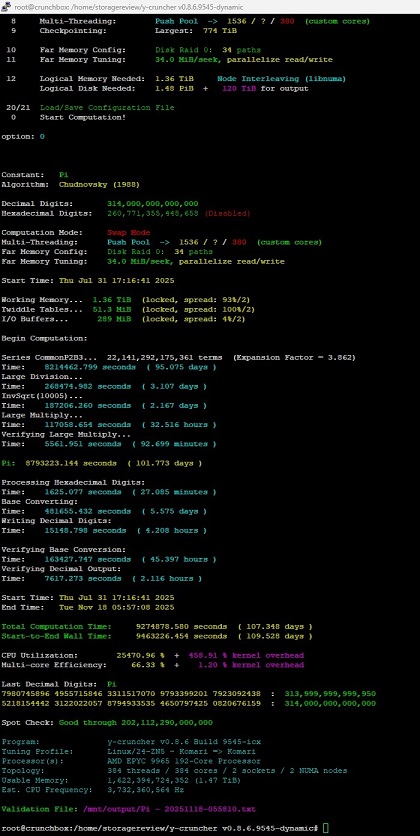
Pi records haven't been standing for very long in recent years and this time is no different. Storage Review has taken the crown back from Linus Media Group with their latest computation of 314 trillion digits of Pi!
While 314 trillion digits isn't much more than the previous record of 300 trillion, the real accomplishment is in how it was achieved.
The computation took only 110 days on a 384-core AMD Epyc server - which is faster than all previous computations. More impressively, it was done in a single contiguous run without any interruptions which is a first in recent history.
Full details of the computation can be found here.
Why is a contiguous run significant?
Ever since Pi computations moved from supercomputers to commodity hardware, the run times for Pi records have shot up from days to months. Because it is difficult to keep a computer running for so long without any interruptions (power outages, hardware failures, etc...), it became up to the software to compensate for hardware/environment unreliability with checkpoint-restart.
Thus modern records all relied heavily on checkpointing to reach the sizes necessary to set a record. In fact, the combination of error-detection and checkpointing has allowed several world record attempts to survive even software error (bugs) in y-cruncher itself!
In short, checkpointing has come a long way... Early implementations of y-cruncher's checkpoint restart (circa 2010) were quite limited and only extended the MTTF (mean time to failure) tolerance by about 10x or so. While it made Pi records on commodity hardware possible, it remained the bottleneck. As the years went by, this problem was not ignored. Thus modern versions of y-cruncher have the fault-tolerance and checkpointing capability that is robust enough to perform computations lasting years. And while no recent computations have actually taken more than a year, quite a few have crossed the 6 month mark, either as planned or due to unforeseen circumstances.
While things have been trending towards this in recent years thanks to solid state storage making computations much faster, this latest compuation from Storage Review has finally shown that it is still possible set a Pi record without needing the checkpoint-restart.
Would I recommend performing a Pi record without checkpointing? Absolutely not. This was actually Storage Review's 3rd attempt at a contiguous run. And while the computations from all 3 attempts finished correctly with a new Pi record, the first two attempts were hit by various hardware and software issues.
Where does Pi race go from here? In my opinion, the sky is the limit.
If you can set a record without using the very feature designed specifically to make it possible, then what will happen when it too is pushed to the limit? We may be at the point where limit of a Pi computation is the point where the result can be achieved faster by waiting for future (faster) hardware that will make up for the time spent waiting for it. In the modern era, I (crudely) estimate that such a crossover point sits at around 2-3 years with the critical component being Moore's Law for storage systems.
Version 0.8.7: (November 23, 2025) - permalink
As some of you may know, development on y-cruncher has been on hiatus as my interests have shifted to other projects. Nevertheless, y-cruncher will continue to be maintained as I do intend to pick it back up in the future.
Basic ISA optimizations and tuning profiles for new processors are relatively low effort and will continue provided that I can get the hardware. It's mostly the big algorithm redesigns and rewrites that are on hold until I come back to this project.
Oh and those launch-day architecture review blogs? Those have been very well received so far. So I'll keep doing them provided that I keep receiving sample hardware.
Misc. Updates: (May 26, 2025) - permalink
Some of you may have already noticed, but SSL and HTTPS are now working for this site. Huge thanks to Jake Tivy for helping me set this up!
Version v0.8.7 is in development with no ETA yet, but it is likely going to be mostly a bug-fix only release with some new tuning profiles. The bugfixes are mostly related to performance on very large systems and thus are not critical enough to cherrypick into v0.8.6.
There is lot that I want to do, but my free time has largely shifted over to my other project. So y-cruncher hasn't gotten much attention in recent months.
In particular, Jorge Zuniga has discovered an entirely new class of (fastest) formulas for log(x) which I have yet to figure out how to implement short of hard-coding the more common cases. And recently, I was given extended access to a fairly large machine which is a prime target for some "big machine scability" experiments that I've wanted to do for years.
|
Pi Computed to 300 Trillion Digits: (May 16, 2025) - permalink
Oh what do we have here? A race between the hardware media outlets?
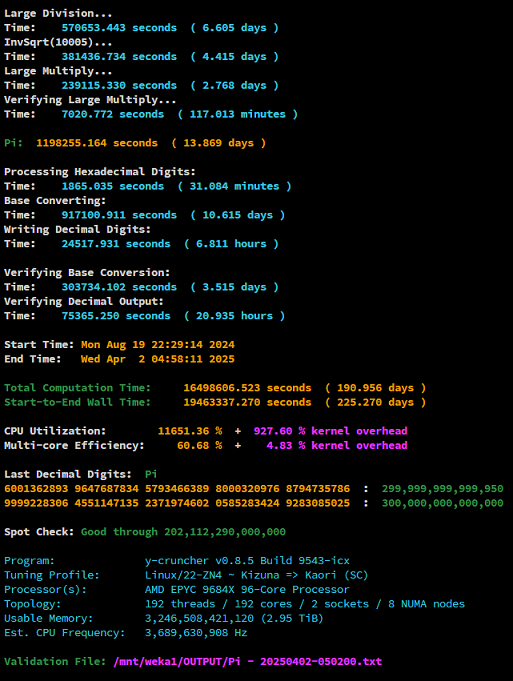
Last year, StorageReview did it twice. Once at 105 trillion digits, and again at 202 trillion. This year, almost 1 year later, it is Linus Media Group (LMG)!
Linus Media Group has been wanting this record for a while - long before StorageReview did their runs from last year. But it wasn't until July last year did Jake Tivy reach out to begin serious discussions for such an attempt - this time with even bigger hardware than StorageReview.
The next month was filled with testing, tuning, and experimenting with various hardware setups. In the process, Jake discovered yet another y-cruncher bug from the v0.8.x rewrite - a bug that StorageReview didn't hit because their hardware wasn't big enough.
(You can read more about how this botched rewrite blew up on StorageReview's 105 trillion digit record from last year.)
Once all the testing and tuning was done, the computation officially began in August and ran all the way until April this year.
Computation Statistics:
Decimal Digits: 300,000,000,000,000 Total Time: 225 days (including ~50 days of downtime)
(August 19, 2024 - April 2, 2025)
CPU: 2 x AMD Epyc 9684X (192 cores, SMT off) Memory: 3.0 TB DDR5 Storage: Swap: 48 x 15.36 TB SSDs + 24 x 30.722 TB SSDs (KIOXIA)
Digit Output: 16 x 15.36 TB KIOXIA SSDs
OS: Ubuntu 22.04 Software: y-cruncher v0.8.5.9543 Validation File: Validation File Verification: Screenshot
At first glance, 225 days for 300 trillion digits sounds very inefficient compared to 104 days for 202 trillion digits. However, there was around ~50 days of downtime from mostly external issues such as power outages and unreliable air conditioning.
So while the 225 days may not have been the best result, both the hardware and the software largely performed to expectations.
See LGM's video for more details!
End of support for HWBOT Integration: (April 4, 2025) - permalink
As some of you may have noticed, y-cruncher v0.8.6 no longer includes the HWBOT submitter application to submit benchmarks to HWBOT. The reason for this is that HWBOT has banned all versions of y-cruncher past v0.8.5 from certain categories due the frequent performance improvements.
Despite strong opposition from both myself as well as the author of BenchMate, HWBOT is sticking to this decision.
After considering these things:
- The HWBOT submitter was always a messy side-project (written in Java) that I've hated to maintain.
- I would need to implement category/version filters in order to abide by HWBOT's new rules.
- My time has largely shifted away from y-cruncher to focus on work and other (unrelated) side-projects.
I have decided that it is best to simply discontinue the HWBOT submitter. So going forward, there will be no further support for HWBOT integration from y-cruncher itself. You will have to rely on BenchMate to submit to HWBOT.
y-cruncher's goals have never aligned well with HWBOT. y-cruncher has always been in the pursuit of maximum performance while HWBOT has always wanted maximum consistency. While HWBOT has managed the performance inconsistencies over the years, it finally reached the breaking point with v0.8.6.
What this means going forward is that any world records found on HWBOT should be taken with a grain of salt as they will be using outdated versions of y-cruncher that are likely slower than the latest and greatest.
New Fastest Formula for Zeta(5): (January 25, 2025) - permalink
As new fastest formula for Zeta(5) has been found by Zhi-Wei Sun which Jorge Zuniga has turned into custom formula file for use in y-cruncher!
The new formula is nearly twice as fast as the previous fastest (Kruse 2019). You can read more about this here.
Zeta(5) is now about as fast to compute as Gamma(1/5) and the Euler-Mascheroni Constant. (which are still slow, but Zeta(5) was previously in a category of its own)
Version 0.8.6 Released: (January 9, 2025) - permalink
Version 0.8.6 has been released. I was originally holding for the (longshot) hope that AMD would announce a dual X3D AM5 chip so I could build a tuning profile for it.
But as AMD has clarified at CES, it was never going to happen...
I wish Intel the best in getting themselves back up to speed. Competition is good for consumers.